
 By
Episode 6 of The Story of Life on Earth follows life out of the water, from the first upright plants of the Silurian to the eight-fingered tetrapods of the Devonian. It is also the story of how the bones in your own hand began as a fish fin.
A Planet of Bare Rock
For most of Earth’s history, the continents were almost empty. Life had been thriving in the oceans for billions of years, but the land was bare rock, scoured by wind, rain and unfiltered ultraviolet light. With nothing growing on it, there was nothing to hold soil in place, and erosion carried loose sediment straight into the sea.
The first colonists were not plants or animals in any familiar sense. They were microbial mats, thin films of microscopic life spreading across damp surfaces, followed by simple non-vascular plants similar to today’s mosses and liverworts. Over millions of years these low, inconspicuous growths began to weather the rock beneath them and trap organic matter. By around 433 million years ago, in the middle of the Silurian period, they had built something the planet had never had before, the first true soils.
Some spores in the fossil record are older still, so plants of some kind may have been on land before then. None of them could grow tall.
Cooksonia and the First Plants to Stand Upright
That changed with Cooksonia, a small forked plant only a few centimeters high. Its bare green stalks were each thinner than a matchstick (0.3 to 3 millimeters across). They forked and ended in spore capsules. There were no leaves and no proper roots. The genus is named for the botanist Isabel Cookson, who collected many of the original specimens, and it was formally described by William Henry Lang in 1937.
What set Cooksonia apart was inside its stems. It had a simple vascular system, internal tissue that could move water and nutrients upward against gravity. A moss has to sit in moisture. Cooksonia could carry its water with it, and that allowed it to stand upright away from a constant water source. It remains the oldest widely recognized plant with unambiguous vascular tissue.
Life out of water posed several problems for a plant. Air dries tissue out, and a waxy cuticle answered that. Nothing holds a stem up once water’s buoyancy is gone, so vascular tissue, and later the stiffening compound lignin, did the job. Reproduction was harder too. Spores, and much later seeds, let plants breed without a surrounding pool. Once vascular plumbing was in place, the rest followed over tens of millions of years. True leaves appeared, then roots, then wood. Ankle-high forks gave way to shrubs, and by the end of the Devonian, around 359 million years ago, bare rock had become forest.
Animals Follow the Plants Ashore
Where plants went, animals followed. Leaf litter and damp soil offered food and cover, and small arthropods were among the first to move in. Meanwhile, in the shallow, weed-choked water along the edges of these new forests, a group of fish was changing too.
These were lobe-finned fish, whose fins were fleshy and supported by bones rather than thin rays alone. Over millions of years in plant-clogged Devonian waterways, some of them evolved unusually sturdy fins. The likeliest explanation is that these fins were useful for shoving through mud and dense vegetation in the shallows. They were not built for walking.
Inside those fins, the bones fell into a familiar arrangement, one bone attached to the body, then two, then a cluster of smaller bones. That is already the layout of a shoulder, an elbow and a wrist. And it evolved in water, before any animal walked on land. Biologists call this exaptation, when a feature that evolved for one purpose is later put to a different use.
Tiktaalik, a Fossil Found by Prediction
The move from fish to four-limbed animal (a tetrapod) long had to be pieced together from scraps of bone that could be read more than one way. No single specimen clearly bridged the gap. That changed in 2004 on Ellesmere Island, in Nunavut in Canada’s high Arctic.
A team led by Neil Shubin of the University of Chicago, working with Edward Daeschler of Philadelphia’s Academy of Natural Sciences, went looking for a transitional fossil in a specific place for a specific reason. Geological maps showed exposed Devonian rock of about the right age, roughly 375 million years old, formed in the kind of ancient freshwater environment where such an animal might have lived. They dug there, and they found what they were looking for.
The animal was named Tiktaalik roseae. The genus name comes from an Inuktitut word for a large freshwater fish, chosen in consultation with Nunavut elders. Specimens came from rock layers dated to roughly 375, 379 and 383 million years old, and the find was published in Nature in April 2006.
Tiktaalik combines features from both sides of the divide. It had scales, gills and fin rays like a fish. It also had a mobile neck, a flattened, crocodile-like skull and wrist-like joints inside its fins, with bones comparable to an upper arm, forearm and wrist. It is still cited as one of the clearest transitional fossils known, and as a textbook case of evolutionary theory producing a testable prediction that turned out to be correct.
Tiktaalik, however, probably never walked in any real sense. It was a fish adapted to the shallows. The animals that did make it onto land were slower, clumsier and, in one case, very much smaller.
Pneumodesmus, the Earliest Known Land Animal
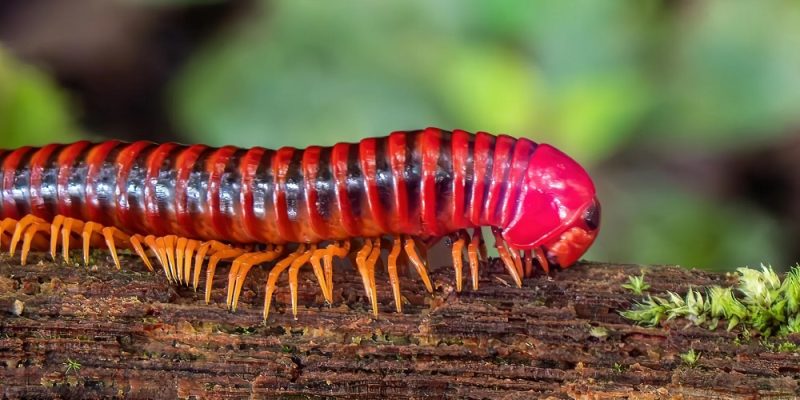
The earliest known land animal is tens of millions of years older than Tiktaalik and smaller than a fingernail. Pneumodesmus newmani is a fossil millipede about one centimeter long, found in 2004 on the foreshore near Cowie Harbour at Stonehaven in Scotland by amateur collector Mike Newman, after whom it is named.
Pneumodesmus preserves spiracles, tiny breathing pores along the side of its body. They show it took its oxygen from the air, not from water, and it is often cited as the oldest known air-breathing animal. Its age is less certain. It was first dated to about 428 million years ago, in the Silurian, but a 2017 zircon dating study put the rocks at roughly 414 million years, in the early Devonian, and the question is still argued over.
Rhyniognatha hirsti, a jaw fragment from Scotland’s roughly 410-million-year-old Rhynie chert, is among the oldest candidate insects, though claims that it had wings remain contested.
Acanthostega, Ichthyostega and the Eight-Fingered Hand
By the late Devonian, true tetrapods had appeared, and two fossils from East Greenland, both living around 365 to 360 million years ago, show what they were like. Both were first collected on Danish-led expeditions beginning in the 1930s, but their significance was not fully appreciated until they were reanalyzed in the 1980s and 1990s.
Acanthostega had legs that could barely have held its body up out of water, and it still had gills inside its head. It lived mostly in the water and used its limbs to paddle through weedy shallows. Its hands were the surprise. Each forelimb carried eight webbed digits.
Its neighbor Ichthyostega was heavier built. Thicker ribs and limbs probably let it drag itself over mud, though only in a slow shuffle, something like a seal on a beach.
The reinterpretation was led by Jennifer Clack of Cambridge University, whose team excavated key Acanthostega specimens in 1987. Her work showed that the eight digits were real, and together with other early tetrapods with more than five fingers, it overturned a long-held assumption. Five digits were not the original or natural number for a vertebrate limb. Early tetrapods were experimenting with different arrangements, and five became the standard only later, for reasons that are still debated.
Tiktaalik and Acanthostega changed the shape of the story. There was no single moment when a fish crawled out. Instead, for millions of years, water-dwelling animals with limbs tried out different hands and bodies, and only later did some of them commit to life on land.
Echoes Today
The most familiar trace of all this is attached to your arm. From shoulder to fingertip, you have one upper bone, two forearm bones, a cluster of wrist bones and then digits. This is the pentadactyl limb pattern, and it is directly homologous to the bones traced in Tiktaalik’s fin and in the limbs of Acanthostega and Ichthyostega. The same layout appears, heavily reshaped, in whale flippers, bat wings, bird wings and horse legs, all inherited from the same Devonian ancestry. The fact that the count settled on five, rather than six or eight, was not inevitable.
Other pioneers have living counterparts too. Modern millipedes still breathe through spiracles on essentially the same plan as Pneumodesmus, more than 400 million years later, and they are probably in a garden near you. Cooksonia’s vascular system is the same basic transport design used by the roughly 300,000 known species of vascular plants alive today, from grasses to trees.
The trends that began here went much further in the following Carboniferous period, 359 to 299 million years ago. Swampy coal forests of giant lycopsid trees such as Lepidodendron and Sigillaria, some over 30 meters tall, covered large parts of the tropics. So much plant growth, and so much dead wood buried before it could rot, may have raised oxygen to 30 to 35 percent of the air. Today it is about 21 percent. In that world, Arthropleura, a millipede relative, reached around 2.6 meters long, and griffenflies such as Meganeura, relatives of modern dragonflies, had wingspans of 65 to 75 centimeters, about the size of a hawk. Rich oxygen is the usual explanation for their size. It may not be the whole answer, since some large griffenflies survived into the Permian after oxygen levels fell. The coal we still burn takes its name from this period, since Carboniferous means “coal-bearing.”
Modern amphibians carry another echo. Most still lay their eggs in water and depend on moist, permeable skin, a way of life that keeps one foot in the habitat their Devonian ancestors were slowly leaving.
Next time you move your wrist, the sequence of one bone, two bones, then digits is a pattern first worked out in shallow Devonian water.
Watch next. Episode 7, The Great Dying, tells how the end-Permian extinction wiped out most of the life that had spread across land and sea.
The Story of Life on Earth is an independent, unofficial documentary series built from original research. It is not affiliated with any publisher, author, or existing book or series.



Comments